



Preface
Dasatinib is a second-generation BCR-ABL1/Src-family tyrosine kinase inhibitor that is licensed only for Philadelphia chromosome-positive chronic myeloid leukaemia (CML) and acute lymphoblastic leukaemia (ALL).[1] In longevity medicine it is used entirely off-label, and only in combination with quercetin (D+Q), as a first-generation senolytic intended to clear senescent cells via intermittent “hit-and-run” dosing.[2][3] The current human evidence base is confined to small early-phase trials reporting feasibility, target engagement (reduced senescent-cell/SASP markers) and surrogate functional endpoints; no trial has demonstrated a hard clinical benefit (mortality, cardiovascular events, incident disease) in a longevity population, and leading investigators state it is “too early for senolytics to be used outside of clinical trials”.[2][4] This summary treats D+Q as experimental/research-grade throughout.
1. Scope
– Covered: Off-label use of dasatinib, always paired with quercetin (D+Q), as a systemic senolytic in adults seen in a private UK longevity clinic; mechanism, human evidence, patient selection, dosing used in trials, monitoring, safety, contraindications and practical scenarios.
– Not covered: Licensed oncological use of dasatinib in CML/ALL (covered only where safety data are extrapolated); other senolytics (fisetin, navitoclax, UBX-series) except for comparison; topical/local senolytic formulations; paediatric use.
– Positioning: Adjunctive to — never a substitute for — conventional primary/secondary care. Given the absence of outcome data, the default position is that D+Q should be offered only within a research/registry framework or, at most, as carefully consented experimental adjunctive care.
2. Background and pathophysiology
Biological rationale. Cellular senescence — stable cell-cycle arrest with a pro-inflammatory senescence-associated secretory phenotype (SASP) — is a hallmark of ageing. Senescent cells accumulate at causal sites of multiple age-related diseases, resist apoptosis through senescent-cell anti-apoptotic pathways (SCAPs), and their transplantation into young mice causes physical dysfunction and shortens survival.[5] In humans, the proportion of p16-positive thigh adipose cells correlates inversely with grip strength (r ≈ −0.74) and walking speed (r ≈ −0.73), and higher circulating SASP burden is associated with worse physical function and increased mortality risk.[4]
Mechanism of D+Q. Identified by Zhu et al. in 2015 through a hypothesis-driven SCAP-screen.[6][7] Dasatinib inhibits Src-family and ephrin/tyrosine kinases (reducing survival signalling and downstream p21/cyclin D1), preferentially killing senescent mesenchymal/pre-adipocyte cells; quercetin inhibits PI3K/AKT and BCL-2/BCL-xL, preferentially targeting senescent endothelial cells.[6][8] The combination therefore covers a broader range of senescent-cell types than either agent alone.[8] Because senescent cells re-accumulate slowly, intermittent dosing is as effective as continuous dosing — the pharmacological basis for “hit-and-run” regimens.[9][2]
The following schematic (Zhang et al., npj Aging, 2026) shows how D+Q disables the SCAP network (PI3K/Src → BCL-2/BCL-xL) to release BAX/BAK and trigger apoptosis: Figure 2 Contrasting survival and apoptosis in senescent cells targeted by first-generation senolytics. A The survival state of a senescent cell is maintained by active anti-apoptotic pathways. Pro-survival signals from pathways involving PI3K and Src Kinase support the function of BCL-2 family proteins (BCL-xL, BCL-2), which act to inhibit the pro-apoptotic proteins BAX/BAK. This robust defense mechanism makes the cell resistant to apoptosis. The nucleus contains senescence-associated heterochromatin foci (SAHF). B First-generation senolytics, such as the Dasatinib and Quercetin (D + Q) cocktail, induce apoptosis by disabling these survival pathways. This leads to the neutralization of BCL-xL and BCL-2, allowing BAX/BAK to become active, permeabilize the mitochondria, and trigger the apoptotic cascade, evidenced by membrane blebbing and cellular fragmentation. Figure created with BioRender.com.
Preclinical evidence (animal/in-vitro only — hypothesis-generating, not a basis for practice). In mice, D+Q reduces senescent-cell burden and improves outcomes across models of frailty, cardiac/vascular ageing, hepatic steatosis and insulin resistance, osteoporosis, pulmonary fibrosis, tau/amyloid neurodegeneration and diabetic kidney disease.[11][12][3][13] Xu et al. reported that intermittent oral senolytics increased post-treatment survival by 36% in naturally aged mice.[5] Effects are inconsistent and highly dosing-/model-dependent (e.g. monthly D+Q failed to reduce hepatic or ovarian senescence where biweekly dosing succeeded).[12] These data do not establish human efficacy.
3. Evidence base and grading
Study types available: Several completed/ongoing phase 1 and small phase 2 trials (typically <3 months, n≈9–60), mostly open-label or pilot RCTs, in disease-specific populations (IPF, diabetic kidney disease, mild Alzheimer’s/MCI, post-menopausal osteoporosis). No large RCTs, no meta-analyses of longevity outcomes, and no prospective cohorts using ageing endpoints exist.[13][2][4]
Outcomes studied: Feasibility/tolerability; target engagement (tissue p16/p21/SA-β-gal, circulating SASP); surrogate functional measures (6-minute walk distance, gait speed, chair-stand); bone-turnover markers; imaging surrogates. Mortality, cardiovascular events and incident age-related disease have not been endpoints in any completed human senolytic trial.[4][14]
| Outcome | Evidence statement | GRADE certainty | Strength of recommendation | Key limitations |
|---|---|---|---|---|
| Senescent-cell/SASP marker reduction (target engagement) | Open-label pilot in diabetic kidney disease (n≈9–11): single 3-day D+Q course reduced adipose p16/p21/SA-β-gal, CD68⁺ macrophages and circulating SASP (IL-1α, IL-6, MMP-9/12) at day 11 [15], [16] | Low | Demonstrates biological target engagement only — not a clinical outcome | Tiny n, no control group for tissue endpoints, skin-biopsy signal retracted in corrigendum [16] |
| Physical function (6-min walk, gait speed, chair-stand) | Open-label IPF pilot (n=14) showed improvement; blinded pilot RCT (n=12) under-powered, no meaningful between-group difference [6], [17], [18] | Very low | Only in research | Open-label training effect; RCT not powered for efficacy; disease-specific (IPF), not longevity population |
| Bone turnover / BMD | Phase 2 RCT, 60 post-menopausal women, D+Q vs placebo (2 days/month ×5): primary endpoint (CTX bone-resorption marker) not met; signal only in subgroup with highest baseline senescence burden [4] | Moderate (for the null primary result) | Recommend against routine use for bone health | Negative primary endpoint; subgroup finding hypothesis-generating |
| Cognition / Alzheimer’s biomarkers | Phase 1 feasibility (mild AD): tolerable, CSF/plasma senescence markers affected; no efficacy claim [3], [14] | Very low | Only in research | Feasibility design, no efficacy endpoint |
| Mortality / cardiovascular events / healthspan | No human data; benefit inferred from mouse survival and mechanistic plausibility only [5], [14] | Very low (indirect) | Only in research | No human outcome trials exist |
Across all outcomes: risk of bias is high (small, often unblinded studies); indirectness is severe (disease-specific populations, surrogate endpoints, not asymptomatic longevity clients); imprecision is severe (wide CIs, tiny samples); publication bias is plausible given field enthusiasm and small positive pilots.[13][2][4][14]
4. Patient selection and indications
There is no evidence-based, guideline-endorsed indication for D+Q in a longevity/preventive setting. Any use is experimental. Where a clinician nonetheless considers it within a research or consented-adjunct framework, the trial-derived populations most plausibly aligned are:
– Who might (theoretically) be considered:
– Older adults (broadly ≥60) with a high measurable senescence/inflammageing burden — the osteoporosis and MCI trials suggest benefit, if any, concentrates in the highest-senescence tertile/subgroup.[12][19]
– Adults with an established senescence-associated condition already under specialist care (e.g. IPF, diabetic kidney disease) where they may qualify for a formal trial.[17][16]
– Inclusion considerations: adequate organ function (marrow, hepatic, renal), no active bleeding risk, no significant cardiopulmonary disease, and capacity for fully informed consent about experimental status.
– Low-priority / poor rationale: young, healthy or athletic individuals seeking “performance” or pre-emptive longevity benefit — no supporting data and a real (if intermittent-dosing-attenuated) toxicity profile; senescence also has physiological roles in wound healing and tumour suppression, so indiscriminate clearance carries theoretical harm.[16]
Exclusion / high-risk groups (avoid, or specialist input only): pre-existing or prior pleural/pericardial effusion, pulmonary hypertension, or significant cardiopulmonary disease (strong contraindication to dasatinib in oncology); QT prolongation/congenital long-QT, uncorrected hypokalaemia/hypomagnesaemia; bleeding diathesis or anticoagulant/antiplatelet therapy; significant cytopenias; pregnancy/breastfeeding (teratogenic); concurrent strong CYP3A4 inhibitors/inducers or QT-prolonging drugs.[20][1][21][22]
Regulatory and ethical status (UK):
– Off-label for all senolytic/longevity indications (dasatinib is MHRA/EMA/FDA-licensed only for CML/ALL). Quercetin is a food-derived flavonoid marketed as a supplement, not a licensed medicine.
– Best practice is use only within a clinical trial or prospective registry; the field’s own investigators explicitly advise against routine clinical use.[2]
– If used as consented adjunctive care outside a trial, follow GMC off-label prescribing standards: document the absence of a licensed alternative, the experimental rationale, discussion of unknown long-term risks, and explicit informed consent; involve the patient’s GP/specialist.
5. Assessment and baseline work-up
History and examination:
– Full cardiovascular, respiratory (dyspnoea, cough, prior effusions), bleeding and medication/supplement history (including grapefruit, St John’s wort, PPIs/H2 blockers, herbal CYP3A4 modulators).[21][1]
– Frailty and functional phenotyping where relevant (e.g. gait speed, chair-stand, short physical performance battery, grip strength) — these are the surrogate endpoints used in trials and provide a reproducible baseline.[4][18]
Baseline investigations tailored to D+Q:
– FBC (myelosuppression risk), U&E/eGFR, LFTs, calcium, magnesium and potassium (correct before dosing given QT risk).[1]
– 12-lead ECG for QTc at baseline; correct electrolytes first.[21][23]
– Baseline echocardiography/chest assessment if any cardiopulmonary history, given the pleural-effusion/PAH signal with dasatinib.[24][25][20]
– Consider baseline senescence/inflammation markers (e.g. circulating SASP panel, hs-CRP, IL-6) for research documentation — but interpret cautiously: these are surrogates not validated as clinical outcome predictors for treatment response.[4]
Risk stratification: Higher harm risk with older age, COPD/prior effusion, cardiac disease, cytopenias, polypharmacy with CYP3A4/QT-active drugs. Potential (unproven) benefit appears concentrated in those with highest baseline senescent-cell burden.[12] Document baseline function and biomarkers to allow meaningful longitudinal comparison.
6. Dosing regimens and practical implementation
There is no established longevity dose. The regimens below are those used in human trials and are quoted for reference only — they are not endorsed for routine practice.
– Most-used intermittent regimen (IPF, AD trials): dasatinib 100 mg/day + quercetin 1,000–1,250 mg/day for 3 consecutive days per week, for 3 weeks (“hit-and-run”).[6][17][3]
– Alternative intermittent regimens: single 3-day course (diabetic kidney disease pilot: D 100 mg + Q 1,000 mg ×3 days); or 2 consecutive days once monthly ×5 months (osteoporosis phase 2).[16][4]
– Dasatinib is taken orally, with or without food; tablets are swallowed whole (not crushed).[1]
– Robust vs extrapolated: These intermittent doses have human safety/feasibility data but no validated efficacy for longevity endpoints; all efficacy inferences are extrapolated from surrogate markers or preclinical survival data and require caution.[2][4]
– No dose–response or optimal-dosing data exist for senolytic use. In oncology, chronic dasatinib 50 mg/day is non-inferior to 100 mg/day with markedly less pleural effusion (2.2% vs 25.2%), which is reassuring context but not directly transferable to intermittent senolytic dosing.[26][27]
7. Monitoring, safety and follow-up
Safety profile. Most published senolytic (intermittent) trials report no serious drug-related adverse events, with disproportionate sleep disturbance and anxiety (4/6 vs 0/6 in the IPF RCT) and mild headache, cough and GI upset.[17][3] One serious event (pneumonia requiring hospitalisation) occurred in the open-label IPF pilot.[6] The following reflect chronic daily oncology dosing and represent the theoretical (largely attenuated by intermittent dosing) ceiling of risk:
– Common (chronic dosing): myelosuppression, fluid retention, diarrhoea, headache, rash, bleeding, dyspnoea, fatigue, musculoskeletal pain, nausea (each ≥15%).[1]
– Pleural effusion: 20–50% with continuous therapy; risk rises with age and COPD; can occur even after years. A dominant FAERS safety signal.[24][20][28]
– Serious but less common: pulmonary arterial hypertension (~0.45%, may be irreversible); QT prolongation; cardiovascular/arterial-occlusive events; severe dermatological reactions (Stevens–Johnson syndrome, erythema multiforme); hepatotoxicity.[24][1][25]
Monitoring plan and timepoints:
– Baseline: FBC, U&E, LFTs, electrolytes (K⁺/Mg²⁺), ECG (QTc); chest/echo assessment if cardiopulmonary history.[1][21]
– During/short-term (first cycle): clinical review for dyspnoea, cough, oedema, bruising/bleeding, rash, mood/sleep symptoms; repeat FBC and electrolytes; ECG after initiation and after any dose change (per TKI monitoring practice).[21][22]
– Medium-term (post-cycle, weeks): reassess function/biomarkers; repeat bloods if symptomatic.
– Long-term: because PAH and effusions can appear late, maintain vigilance for new respiratory or cardiac symptoms even after cycles complete. Long-term safety of repeated senolytic cycles is unknown.[25][1][11]
Actions for abnormal findings: new dyspnoea/effusion or suspected PAH → stop D+Q, chest imaging, refer to respiratory/cardiology; significant cytopenia → interrupt and recheck; QTc prolongation → stop, correct electrolytes, review interacting drugs; severe mucocutaneous reaction → permanent discontinuation.[21][1]
Special populations: avoid in pregnancy and breastfeeding (teratogenic); caution and specialist input in[21] hepatic impairment (dasatinib is CYP3A4-metabolised);[1] frailty/extremes of age raise effusion and bleeding risk — use the most conservative approach or defer.[24][20]
Drug–drug and food interactions (clinically important):
– Strong CYP3A4 inhibitors (azole antifungals, clarithromycin, ritonavir) and grapefruit/starfruit/pomegranate markedly increase dasatinib exposure (ketoconazole raised AUC ~5-fold) → avoid; reduce dose if unavoidable.[21][23][1]
– Strong CYP3A4 inducers (rifampicin, St John’s wort) reduce exposure → avoid.[21][1]
– QT-prolonging drugs (antiarrhythmics, some antibiotics/antidepressants, antiemetics): additive risk — avoid or ECG-monitor.[21][29][30]
– PPIs, H2 antagonists and antacids reduce dasatinib absorption — avoid co-administration/separate dosing.[21][1]
– Anticoagulants/antiplatelets: increased bleeding risk with dasatinib’s platelet effects.[1][22]
– Note that quercetin itself is a CYP3A4 modulator/flavonoid, adding interaction uncertainty.
The NCCN drug-interaction reference for dasatinib (and other TKIs) is a useful point-of-care aid: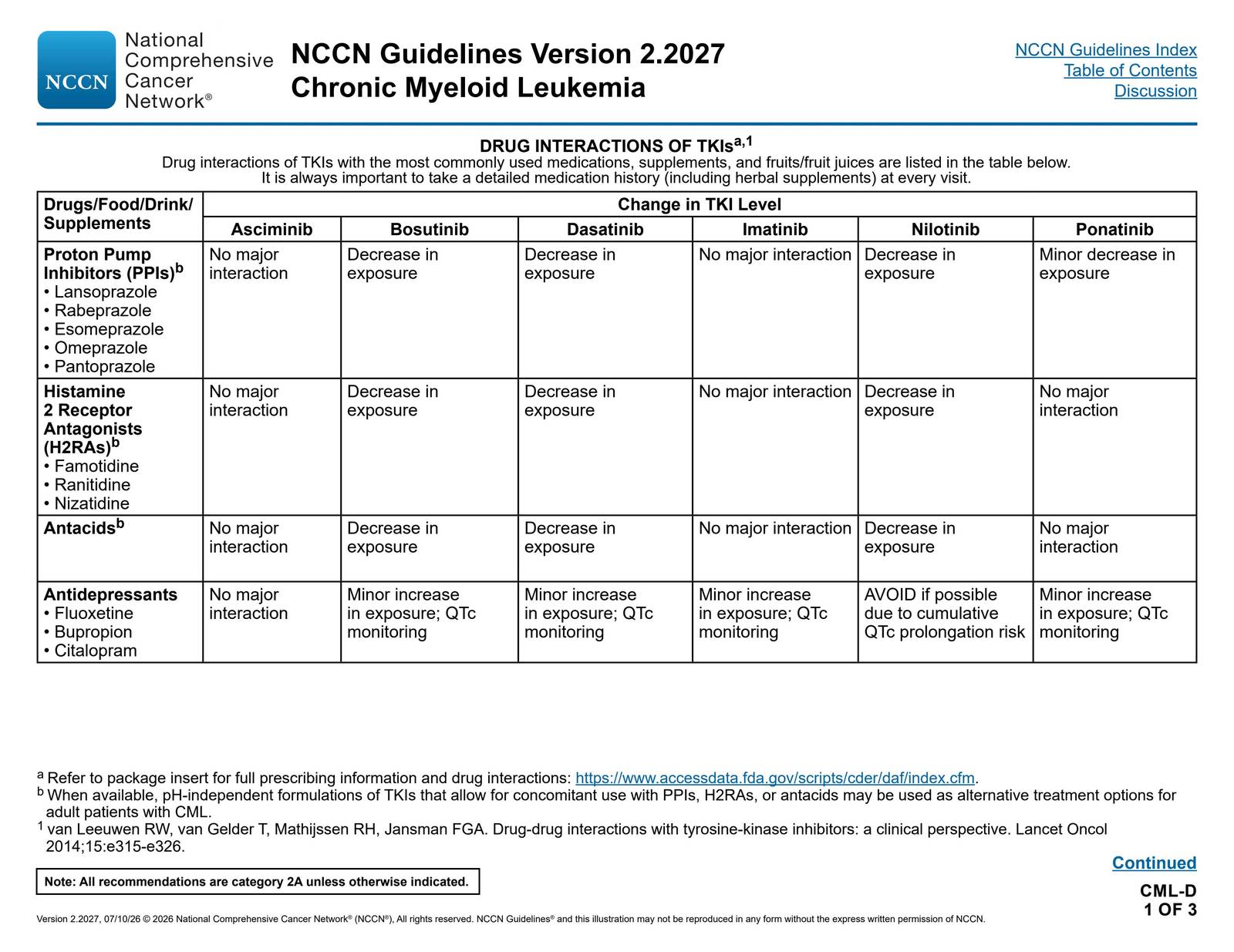 CML-D-1 Chronic Myeloid Leukemia: Drug Interactions of TKIs — NCCN Guidelines® — Chronic Myeloid Leukemia p. 22 (v2.2027)
8. Contraindications and cautions
– Absolute: pregnancy/breastfeeding; known severe hypersensitivity/prior severe mucocutaneous reaction to dasatinib; confirmed pulmonary arterial hypertension.[21][1]
– Strong contraindications (avoid): active or prior pleural/pericardial effusion, significant cardiopulmonary disease, respiratory failure risk; active clinically significant bleeding.[20]
– Relative / specialist advice required: congenital long-QT or QTc prolongation, uncorrected hypokalaemia/hypomagnesaemia; anticoagulant/antiplatelet therapy; significant cytopenias; hepatic impairment; unavoidable strong CYP3A4 inhibitor/inducer or QT-prolonging co-medication; frailty and advanced age.[1][21]
– Harm likely to outweigh benefit with current evidence: asymptomatic younger/healthy individuals seeking longevity enhancement, where there is no efficacy evidence and a non-zero toxicity and theoretical tumour-suppression/wound-healing risk.[16]
9. Practical management scenarios
Scenario A — Middle-aged patient with multiple cardiometabolic risk factors requesting D+Q for “prevention.”
– Recommendation: Only in research (do not offer as routine care). Strength: strong, against routine use. No trial supports senolytic use for primary cardiometabolic prevention; human evidence is limited to surrogate markers in disease-specific cohorts.[4][14]
– Assessment: cardiometabolic and bleeding/cardiopulmonary risk review; medication/supplement reconciliation for CYP3A4/QT interactions; baseline bloods, electrolytes, ECG.
– Shared decision-making: explain off-label/experimental status, absence of outcome data, and that guideline-based cardiometabolic risk reduction (statins, BP control, glycaemic management, lifestyle) has proven benefit and takes priority.
– Initiation: ideally enrol in a trial/registry rather than prescribe; if consented adjunct pursued, use the lowest-exposure intermittent regimen with full documentation.
– Monitoring/stop criteria: as in Section 7; stop for any respiratory, cardiac, bleeding, or dermatological signal.
Scenario B — Older, frail patient with multimorbidity.
– Recommendation: Avoid outside a trial. Strength: strong. Frailty is the theoretically most rational target, but older/frail patients carry the highest risk of effusion, bleeding and drug interactions, and no RCT shows functional benefit in this group.[24][4][20]
– Assessment: frailty and functional phenotyping, cardiopulmonary and cognitive assessment, full polypharmacy interaction check, baseline bloods/ECG.
– Shared decision-making: emphasise unproven benefit and heightened harm risk; prioritise evidence-based interventions (resistance exercise, nutrition, deprescribing).
– If pursued (trial context only): conservative intermittent dosing, intensified monitoring, low threshold to stop and refer.
Scenario C — Patient already under specialist care for a senescence-associated condition (e.g. IPF, diabetic kidney disease), asking about D+Q as an adjunct.
– Recommendation: Restrict to research/specialist-led care. Strength: conditional. These are the exact populations in which pilot trials were conducted, so referral to an appropriate clinical trial is the preferred route.[6][17][16]
– Assessment/consent: coordinate with the treating specialist; confirm no contraindication (e.g. effusion history in IPF); reconcile interacting therapies.
– Initiation/monitoring: only within the specialist’s or trial’s protocol; shared monitoring of organ-specific and senolytic-specific toxicities.
– Escalate/stop: any deterioration in the underlying condition, new effusion/PAH, or serious adverse event → stop and refer.
10. Research gaps and future directions
– No hard-outcome data: whether D+Q reduces mortality, cardiovascular events, incident disease, or improves healthspan in humans is unknown; all current human endpoints are surrogates.[4][14]
– Biomarker–outcome linkage: reductions in p16/p21/SASP demonstrate target engagement but are not validated to predict clinical benefit; validated, standardised senescence biomarkers are a priority.[4]
– Optimal dosing: best dose, cycle frequency, duration and long-term safety of repeated cycles are undefined; preclinical data show marked regimen-dependence.[12][11]
– Patient stratification: the recurring signal that benefit concentrates in those with highest baseline senescence burden needs prospective testing.[12][19]
– Long-term risks: effects of repeated senolysis on wound healing, immune surveillance and tumour suppression require dedicated study.[16]
– Where practice should sit now: current use should be limited to well-designed, blinded, placebo-controlled RCTs and prospective registries, not routine clinical prescribing.[2]
References
- Dasatinib. Food and Drug Administration. Updated date: 2024-07-09.
- Senolytic Drugs: From Discovery to Translation. Kirkland JL, Tchkonia T. Journal of Internal Medicine. 2020;288(5):518-536. doi:10.1111/joim.13141.
- Senolytic therapy in mild Alzheimer’s disease: a phase 1 feasibility trial. Gonzales MM, Garbarino VR, Kautz TF, et al. Nature Medicine. 2023;29(10):2481-2488. doi:10.1038/s41591-023-02543-w.
- Geroscience. Kritchevsky SB, Cummings SR. JAMA. 2025;334(12):1094-1102. doi:10.1001/jama.2025.11289.
- Senolytics improve physical function and increase lifespan in old age. Xu M, Pirtskhalava T, Farr JN, et al. Nature Medicine. 2018;24(8):1246-1256. doi:10.1038/s41591-018-0092-9.
- Fueling the Fire: Metabolic Dysfunction and Senescence as Drivers of Lung Aging and Disease. Kliment CR, Gurkar AU, Cárdenes N, et al. Physiological Reviews. 2026;106(3):1535-1591. doi:10.1152/physrev.00024.2025.
- Immunotherapy and senolytics in head and neck squamous cell carcinoma: phase 2 trial results. Liu N, Wu J, Deng E, et al. Nature Medicine. 2025;31(9):3047-3061. doi:10.1038/s41591-025-03873-7.
- Impact of Geroscience on Therapeutic Strategies for Older Adults With Cardiovascular Disease: JACC Scientific Statement. Forman DE, Kuchel GA, Newman JC, et al. Journal of the American College of Cardiology. 2023;82(7):631-647. doi:10.1016/j.jacc.2023.05.038.
- The Achilles’ heel of cancer survivors: fundamentals of accelerated cellular senescence. Shafqat S, Arana Chicas E, Shafqat A, Hashmi SK. The Journal of Clinical Investigation. 2022;132(13):e158452. doi:10.1172/JCI158452.
- Emerging strategies in senotherapeutics: from broad-spectrum senolysis to precision reprogramming. Zhang W, Song S, Zhang Y, et al. NPJ Aging. 2026;12(1):92. doi:10.1038/s41514-026-00355-z.
- Therapeutic targeting of senescent cells in the CNS. Riessland M, Ximerakis M, Jarjour AA, Zhang B, Orr ME. Nature Reviews. Drug Discovery. 2024;23(11):817-837. doi:10.1038/s41573-024-01033-z.
- Translating cellular senescence research into clinical practice for metabolic disease. Chaib S, Palmer AK, Wyles SP, et al. Nature Reviews. Endocrinology. 2026;22(2):102-115. doi:10.1038/s41574-025-01187-9.
- Cellular senescence and senolytics: the path to the clinic. Chaib S, Tchkonia T, Kirkland JL. Nature Medicine. 2022;28(8):1556-1568. doi:10.1038/s41591-022-01923-y.
- Cellular Senescence, Inflammaging and Cardiovascular Disease. Zanders L, Arifaj D, Wagner JUG, Dimmeler S. Immunological Reviews. 2026;337(1):e70084. doi:10.1111/imr.70084.
- Cellular senescence: a key therapeutic target in aging and diseases. Zhang L, Pitcher LE, Yousefzadeh MJ, et al. The Journal of Clinical Investigation. 2022;132(15):e158450. doi:10.1172/JCI158450.
- Targeting senescent cells in ageing-related endocrine diseases. Stokar J. Nature Reviews. Endocrinology. 2023;19(7):382. doi:10.1038/s41574-023-00848-x.
- Senolytics Dasatinib and Quercetin in Idiopathic Pulmonary Fibrosis: Results of a Phase I, Single-Blind, Single-Center, Randomized, Placebo-Controlled Pilot Trial on Feasibility And tolerability. Nambiar A, Kellogg D, Justice J, et al. EBioMedicine. 2023;90:104481. doi:10.1016/j.ebiom.2023.104481.
- Clinical Trials Targeting Aging. Nielsen JL, Bakula D, Scheibye-Knudsen M. Frontiers in Aging. 2022;3:820215. doi:10.3389/fragi.2022.820215.
- Targeting DNA damage in ageing: towards supercharging DNA repair. Bujarrabal-Dueso A, Garinis GA, Robbins PD, Vijg J, Schumacher B. Nature Reviews. Drug Discovery. 2025;24(10):785-807. doi:10.1038/s41573-025-01212-6.
- European LeukemiaNet 2020 recommendations for treating chronic myeloid leukemia. Hochhaus A, Baccarani M, Silver RT, et al. Leukemia. 2020;34(4):966-984. doi:10.1038/s41375-020-0776-2.
- Chronic Myeloid Leukemia. National Comprehensive Cancer Network. Updated 2026-07-10.
- Safety profiles of second‐line tyrosine kinase inhibitors in patients with chronic myeloid leukaemia. Tinsley SM. Journal of Clinical Nursing. 2010;19(9-10):1207-18. doi:10.1111/j.1365-2702.2009.03167.x.
- Phase 1 Pharmacokinetic and Drug-Interaction Study of Dasatinib in Patients With Advanced Solid Tumors. Johnson FM, Agrawal S, Burris H, et al. Cancer. 2010;116(6):1582-91. doi:10.1002/cncr.24927.
- Tyrosine kinase inhibitors in chronic myeloid leukaemia: which, when, for whom?. Rosti G, Castagnetti F, Gugliotta G, Baccarani M. Nature Reviews. Clinical Oncology. 2017;14(3):141-154. doi:10.1038/nrclinonc.2016.139.
- Chronic Myeloid Leukaemia. Cortes J, Pavlovsky C, Saußele S. Lancet (London, England). 2021;398(10314):1914-1926. doi:10.1016/S0140-6736(21)01204-6.
- Management of Chronic Myeloid Leukemia in 2025. Kantarjian H, Breccia M, Haddad FG, et al. Cancer. 2025;131(14):e35953. doi:10.1002/cncr.35953.
- Efficacy and Safety of 50 mg Versus 100 mg Daily Frontline Dasatinib Therapy in Chronic-Phase Chronic Myeloid Leukemia: A Non-Controlled, Observational Dose-Comparative Cohort Study. Cheng F, Wang F, Cui Z, et al. BMC Cancer. 2026;26(1):367. doi:10.1186/s12885-026-15719-7.
- Toward the Future Management of Patients With CML and Ph + ALL: Real-World Safety Insights From Dasatinib Pharmacovigilance. Lu Z, Shang G, Zeng Y, Lu X. Frontiers in Medicine. 2025;12:1709089. doi:10.3389/fmed.2025.1709089.
- Cardio-Oncology Drug Interactions: A Scientific Statement From the American Heart Association. Beavers CJ, Rodgers JE, Bagnola AJ, et al. Circulation. 2022;145(15):e811-e838. doi:10.1161/CIR.0000000000001056.
- Drug-Drug Interactions With Tyrosine-Kinase Inhibitors: A Clinical Perspective. van Leeuwen RW, van Gelder T, Mathijssen RH, Jansman FG. The Lancet. Oncology. 2014;15(8):e315-26. doi:10.1016/S1470-2045(13)70579-5.